

for Storage Tank Rebottoming Projects
FEATURED PAPER
By Abdullah Arief Su’aidy
Yogyakarta, Indonesia
ABSTRACT
Storage tank rebottoming projects are repetitive yet complex maintenance activities that require consistent scope definition, cost estimation, and project governance. However, current practices often lack standardized Work Breakdown Structures (WBS) and Bill of Quantity (BoQ) templates, leading to inconsistencies and limited cost comparability. This study aims to develop a standardized multidimensional WBS, integrate OmniClass classification into the WBS to standardize BoQ templates, and establish a WBS–OBS integration model to improve project governance. A Multi-Attribute Decision Making (MADM) approach using the Weighted Sum Model (WSM) was applied to evaluate four WBS alternatives. The results indicate that the OmniClass-based multidimensional WBS is the most effective, enabling standardized BoQ development using the US National Park Service (NPS) Class A template and improving accountability through WBS–OBS integration.
Keywords: Work Breakdown Structure, Storage Tank Rebottoming, Multidimensional WBS, OmniClass, Project Scope Management, Maintenance Projects
INTRODUCTION
- 1. Industry Context and Strategic Importance of Storage Tank Integrity
Fuel storage tanks constitute critical infrastructure within the downstream petroleum supply chain and play a key role in ensuring reliable fuel distribution and national energy security. Maintaining the structural integrity of these facilities is essential to prevent environmental incidents, operational disruptions, and financial losses caused by leakage or structural failure. API 653 states, “periodic inspection, repair, and maintenance activities are fundamental elements of asset integrity management programs for aboveground storage tanks”.[1]
In the downstream operations of the Indonesian national oil company, storage tank maintenance activities account for a significant share of operational projects. Maintenance records from the Central Java regional operations indicate that deterioration of tank bottom plates is among the most frequently encountered repair cases.
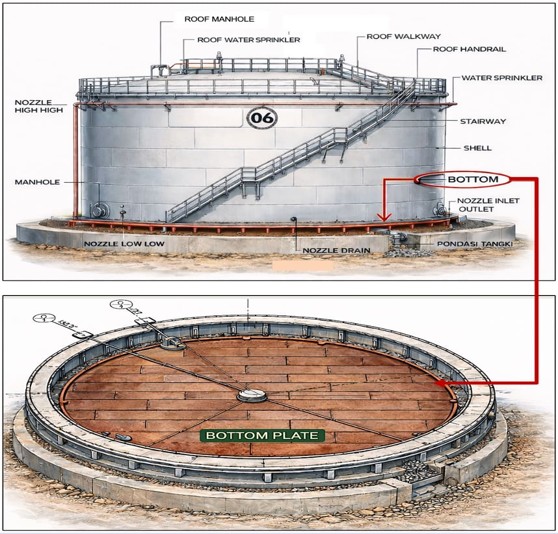
Figure 1 – Typical Structural Components of an Aboveground Storage Tank [2]
Figure 1 illustrates the principal structural components of a typical aboveground storage tank, including the roof structure, shell plates, bottom plate, nozzles, and safety equipment. In accordance with API 653, “Understanding these structural elements is important when evaluating maintenance activities such as tank rebottoming”.[3]
More…
To read entire paper, click here
Author’s note: This paper was originally prepared during a 6-month long Graduate-Level Competency Development/Capacity Building Program developed by PT Mitrata Citragraha and led by Dr. Paul D. Giammalvo to prepare candidates for AACE CCP or other Certifications. https://build-project-management-competency.com/our-faqs/
How to cite this paper: Su’aidy, A.A. (2026). Developing a Standardized Integrated WBS for Storage Tank Rebottoming Projects (A Case Study); PM World Journal, Vol. XIV, Issue VII, July. Available online at https://pmworldjournal.com/wp-content/uploads/2026/07/pmwj166-Jul2026-Suaidy-Standard-WBS-for-Rebottoming-Projects.pdf
About the Author

Abdullah Arief Su’aidy
Yogyakarta, Indonesia

Abdullah Arief Su’aidy is an engineer with over six years of professional experience in the oil and gas sector. Currently, he works as a maintenance engineer at the national oil company of Indonesia. Several projects have been completed in various downstream oil and gas projects, including fuel terminal, LPG terminal, and related infrastructure, with a focus on maintenance and asset reliability. He holds a bachelor of Computer Science in Informatics from STMIK Indonesia Banjarmasin. He is attending a distance learning mentoring course, under the tutorage of Dr. Paul D. Giammalvo, CDT, CCE, MScPM, MRICS, GPM-m, Senior Technical Advisor at PT Mitratata Citragraha to attain Certified Cost Professional (CCP) certification from AACE International.
Abdullah lives in Yogyakarta, Indonesia, and can be contacted at: abdullah.aace.2026@gmail.com
[1] American Petroleum Institute. (2014). API standard 653: Tank inspection, repair, alteration, and reconstruction. API Publishing.
[2] By Author.
[3] American Petroleum Institute. (2014). API standard 653: Tank inspection, repair, alteration, and reconstruction. API Publishing.