

Project Management Lessons from Nepal’s
Flood Disaster (August 2026)
September 2026 Project Management Update from Nepal
REPORT
By Yamanta Raj Niroula
International Correspondent
Kathmandu, Nepal
- Introduction
The catastrophic flood and debris-flow event of 26 August 2026 along the Bhotekoshi[1] and Trishuli corridors has placed Nepal’s early-warning capability under intense scrutiny. The event developed in a high-mountain environment where a rapidly evolving source-area process generated a destructive downstream flood and debris-flow sequence. The United States Geological Survey has described the event as a debris flow and flood likely triggered by rapid slope failure involving a glacier, while cautioning that the precise geological interpretation remains subject to further investigation. That qualification matters because the assessment should remain grounded in what was knowable at the time, rather than treating an evolving scientific interpretation as if it had been established before the event.
The immediate temptation after a disaster is to ask whether the warning system worked or failed. That question is understandable, but it is too broad to be useful without first defining what the system was required to detect, how quickly it was expected to detect it, who was authorized to act, how warnings were to reach exposed populations and how much time people actually needed to reach safety. Nepal possesses substantial elements of an early-warning capability, including hydrometeorological monitoring, forecasting arrangements, communications infrastructure and community-based warning experience. The existence of these components, however, does not establish that the integrated system can provide adequate protection for every credible hazard scenario.
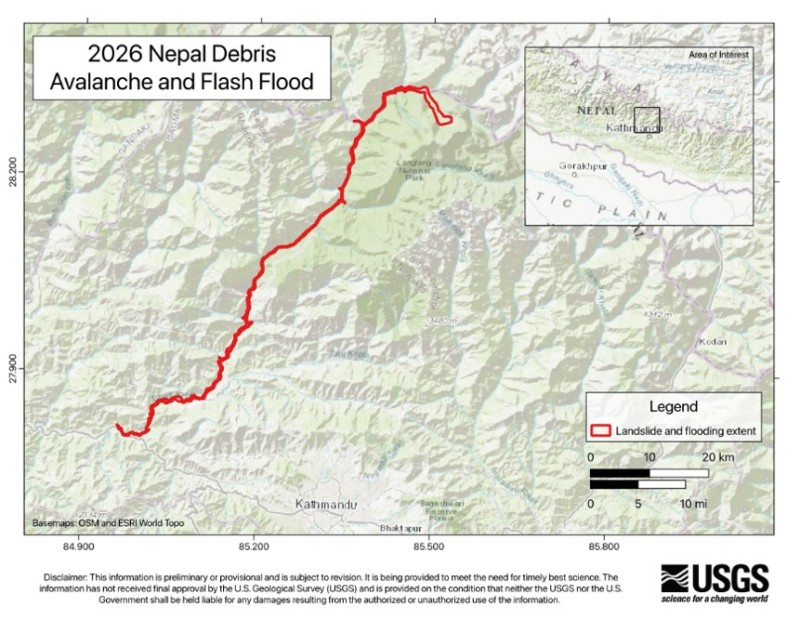
Figure 1: Spatial extent of the 26 August 2026 Nepal debris avalanche and flash flood (Source: U.S. Geological Survey, 2026). The event propagated from the high-mountain source area through the Lhende Khola, Bhotekoshi and Trishuli river systems, illustrating the geographic scale over which warning capability must operate.
This distinction is the starting point for an analysis. Early-warning capability is often delivered through several investments and institutional workstreams: monitoring networks, forecasting systems, telecommunications, alert platforms, emergency procedures, community preparedness and infrastructure for evacuation. Each can have its own scope, budget, schedule, contractor, owner and acceptance process. Yet the public benefit is created only when these separate components operate together under the conditions for which protection is required. A monitoring station may function correctly while providing information too late. A forecast may be scientifically sound while reaching a decision-maker after the useful warning window has narrowed. An alert may be transmitted successfully while recipients lack sufficient time, information or access to safety.
The central thesis of this report is therefore that an early-warning programme should be managed as an integrated, lifecycle operational capability rather than as a collection of technology projects. Its principal deliverable should not be defined by the number of stations installed, messages transmitted or people trained, although those remain important project outputs. The more meaningful deliverable is the amount of reliable, actionable protective time that the system can demonstrate under defined hazard scenarios, including credible failures of critical components. This shifts the project management focus toward requirements definition, systems integration, risk management, interface management, testing, benefits realisation, lifecycle financing and controlled re-baselining after major events.
More…
To read entire report, click here
How to cite this work: Niroula, Y. R. (2026). When the Time Runs Out: Project Management Lessons from Nepal’s Flood Disaster (August 2026), report, PM World Journal, Vol. XV, Issue IX, September. Available online at: https://pmworldjournal.com/wp-content/uploads/2026/09/pmwj168-Sep2026-Niroula-When-Time-Runs-Out-report-1.pdf
About the Author

Yamanta Niroula
Kathmandu, Nepal

Yamanta Niroula is a seasoned Project Management Professional with over 17 years of extensive experience in engineering, infrastructure development, and project management across diverse global environments. His expertise includes project planning, procurement, contract management, stakeholder coordination, and risk mitigation, with a strong focus on executing projects in remote and developing regions under complex operational conditions.
Yamanta holds a Bachelor of Engineering in Civil Engineering and a Master of Arts in Rural Development, along with a Diploma in Civil Engineering. He is a certified Project Management Professional (PMP®) and an active member of the Project Management Institute (PMI) since 2010.
Yamanta has extensive experience in project management, successfully overseeing all stages of construction projects from initial planning to final evaluation. He specializes in managing complex processes, including procurement, contracting, and execution, while maintaining efficiency and regulatory compliance. By staying updated on industry standards and advancements, he has ensured that projects are forward-thinking, sustainable, and adaptable to changing environments.
Yamanta has successfully managed large-scale infrastructure projects, including roads, electrical infrastructure, wastewater treatment plants, logistics facilities, and disaster recovery programs. He has served in various capacities as Project Controls Specialist, Design Manager, Planning Manager, Engineer and Project Manager across international organizations and UN agencies in Nepal, the Maldives, Singapore, Afghanistan, the Philippines, Nigeria, Yemen, Sudan, and Ethiopia.
He has been responsible for project design, planning, execution, and control, ensuring timely delivery, budget adherence, and quality assurance while enhancing overall program outputs.
Yamanta lives in Kathmandu, Nepal and can be contacted at niroulayr@gmail.com
View his full correspondent profile at https://pmworldlibrary.net/yamanta-raj-niroula/
To view other works by Yamanta Ray Niroula, visit his author showcase at https://pmworldlibrary.net/authors/yamanta-raj-niroula/
[1] The Bhotekoshi River affected in this event is the uppermost reach of the Trishuli River system; it is a distinct river from the larger Bhotekoshi (a Sun Koshi tributary) roughly 65 kilometers to the east, which was not affected by the 26 August event. As of this writing, Nepal Police had confirmed more than 780 deaths and over 2,500 people missing across the affected districts, with additional deaths and several hundred missing reported across the border in Tibet. These figures are continuing to change as search-and-rescue operations proceed, and are cited here only to establish the human scale behind the systems-level questions this report addresses.