

BOOK REVIEW
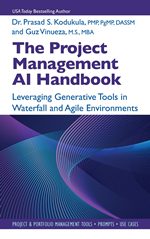 Book Title: The Project Management AI Handbook: Leveraging Generative Tools in Waterfall and Agile Environments
Authors: Dr. Prasad Kodukula and Guz Vinueza
Publisher: J. Ross Publishing
List Price: $59.95
Format: Hardcover, 334 pages
Publication Date: 2025
ISBN: 978-1-60427-205-5
Reviewer: Prof. Shankar Sankaran PhD, PMP, PMI Fellow
Review Date: July 2026
The book titled ” The Project Management AI Handbook: Leveraging Generative Tools in Waterfall and Agile Environments” by Dr. Prasad Kodukula and Gus Vineza stands out among resources for project managers and teams seeking to responsibly leverage Artificial Intelligence (AI), particularly Generative AI (Gen AI), to enhance project performance and deliver results while addressing ethical considerations in human-AI collaboration.
While many books on AI in project management focus on applying AI for specific project tasks, this book aims to cater to both newcomers and experienced project team members who are keen to integrate AI into their project management practices. It achieves this through a systematic approach, first discussing essential project and portfolio management principles, their key functions, and activities, before explaining how AI can support these functions in use cases. Even when AI usage in the Use cases is detailed the tasks for which AI is used and its importance are also clearly explained so that this book also serves newcomers to projects.
While explaining how AI can support project management both waterfall and agile approaches are explained before demonstrating how AI can be utilized in either methodology.
A highlight of this book is its logical four-section structure.
Section 1: AI in Project Management
In this section, the authors clearly articulate the book’s intent: to help project teams and managers enhance efficiency and productivity by partnering with AI for administrative and procedural tasks. AI can assist project teams in managing time and cost, assessing risks, engaging stakeholders, allocating resources, and handling project documentation for scope definition and reporting. The book also explores how AI tools can support project portfolio management by screening and ranking projects, categorizing them into funding buckets, and ensuring alignment with the organization’s strategic objectives and the projects’ missions.
The authors define AI and its classifications, explain how AI learns through different forms of machine learning, and trace its evolution before discussing the rapid development and impact of Generative AI on our lives and on project management. This provides an excellent introduction for those unfamiliar with AI and its relevance at operational, tactical, and strategic levels, and how it improves project results and outcomes. The section concludes by exploring AI’s potential evolution from a useful tool to a strategic partner, given its ability to process vast amounts of data and offer predictive capabilities. The authors advocate that leaders in both organizations and projects must address the challenges of adopting AI to ensure its contribution to project delivery is carefully managed, considering both risks and opportunities.
More…
To read entire Book Review, click here
How to cite this review: Sankaran, S. (2026). The Project Management AI Handbook: Leveraging Generative Tools in Waterfall and Agile Environments, book review, PM World Journal, Vol. XV, Issue VIII, August. Available online at https://pmworldjournal.com/wp-content/uploads/2026/08/pmwj167-Aug2026-Sankaran-PM-AI-Handbook-book-review.pdf
About the Reviewer

Prof Shankar Sankaran, PE
Sydney, Australia

Shankar Sankaran PhD, PMP, PMI Fellow, is Professor of Organizational Project Management at the University of Technology Sydney (UTS) Australia. He is a member of the faculty of Design and Society at UTS where he teaches advance level subjects at the Master of Project Management course including Project Governance, Project Leadership, Digital Transformation and Systems Thinking. His research areas are in project governance, project leadership, sociotechnical systems, and action research. Shankar has won awards for research excellence from PMI and IPMA. He is a Chief Investigator in two Australian Research Council (ARC) funded research grants, one in an Industry Transformation Research Hub for Human Robot Teams for Sustainable and Resilient Construction and Project Governance and Governmentality as Collaborative Challenges.
Shankar has been involved in the publication of 15 books including a research handbook on project governance and has published and/or presented over 150 peer reviewed research publications in international conferences and journals. Shankar worked for several years in industry as a project manager, and a technical director in a Japanese MNC in Singapore before joining academia in Australia in 1999. He has been serving a PMI as a Volunteer for over 20 years including serving as a Chair of the Board of PMI’s Global Accreditation Centre, and as an Associate Editor of Project Management Journal.
Shankar is also a member of the College of Leadership and Management’s Sydney Committee at Engineers Australia where he works with other committee members to promote project governance to improve the performance of major projects in Australia. Shankar is an Honorary Academic Advisor of PM World Journal from Australia
Editor’s note: Authors of book reviews published in the PM World Journal can normally receive professional development units (PDUs) from the Project Management Institute (PMI) or continuing education units (CEUs) from other professional bodies for certification or recertification purposes. Reviewed books should be directly or indirectly related to program, portfolio or project management.
If you would like us to publish a book review or are an author or publisher of a project management-related book, and would like the book reviewed, please contact editor@pmworldjournal.com.