

BOOK REVIEW
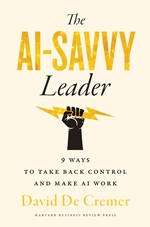 Book Title: The AI-Savvy Leader: Nine Ways to Take Back Control and Make AI Work
Author: David De Cremer
Publisher: Harvard Business Review Press
List Price: $32.00
Format: Hardcover, 224 pages
Publication Date: June 2024
ISBN: 13:978-1-64782-623-9
Reviewer: Anzar Ali Hasan
Review Date: December 2025
Introduction
David De Cremer’s The AI-Savvy Leader critiques the belief that AI failures are purely technical, arguing instead that they stem from a crisis of disengaged human leadership. De Cremer demonstrates that many executives mistakenly embrace the “tech-driving-tech myth,” deferring critical decisions to technical experts, leading to colossal, wasted investments. This perspective is vital, with experts noting that De Cremer “absolutely nails the key drivers behind AI failures,” showing “how we need human leadership more than ever!”
Fortunately, the book provides “9 Ways to Take Back Control and Make AI Work. This text is an “excellent counterbalance to what has been an overwhelmingly technology-led narrative, focusing on applying core leadership skills like emotional intelligence and communication, to bridge the gap between people and technology. Leaders are guided to adopt a human-centered approach that uses AI to augment human capabilities rather than replace them, making the book a “masterful guide offering invaluable insights” and providing “clear answers” where other texts fall short.
Overview of Book’s Structure
The structure of The AI-Savvy Leader is built around the fundamental argument that successful AI adoption is contingent upon engaged, human-centric leadership, The book opens with an Introduction, titled The next great leadership challenge, which establishes the book’s core premise: that AI failures stem from leaders’ disengagement and abdication of responsibility to technical experts, believing the myth that technology should drive the transformation, This sets the stage for the book’s subsequent nine chapters, which are dedicated to specific leadership actions necessary to reverse this trend, Although the chapters can be read out of order, the material is designed to be intertwined and build on each other for maximum benefit.
The core of the book is defined by the “9 Ways to Take Back Control and Make AI Work”, which are nine key leadership responsibilities translated for the digital age. These chapters guide leaders toward adopting Perspective 2 thinking using AI to augment human intelligence and actively refuting the flawed Perspective 1 assumption that they should defer control to technology. These nine actions are: 1) LEARNING (Get to know AI, and learn to use it as a leader); 2) PURPOSE (Use your purpose to ask the right kind of questions); 3) INCLUSION (Work in inclusive ways to drive human-AI collaborations); 4) COMMUNICATION (Build a flat communication culture to drive AI adoption); 5) VISION (Be visionary in how to use AI); 6) BALANCE (Adopt AI with all stakeholders in mind); 7) EMPATHY (Use a human-centered approach to AI adoption); 8) MISSION (Augment (don’t automate) to create jobs); and 9) EMOTIONAL INTELLIGENCE (Accept that soft skills are the new hard skills and practice them).
More…
To read entire Book Review, click here
How to cite this work: Hasan, A. A. (2026). The AI-Savvy Leader: Nine Ways to Take Back Control and Make AI Work, book review, PM World Journal, Vol. XV, Issue I, January. Available online at https://pmworldjournal.com/wp-content/uploads/2026/01/pmwj160-Jan2026-Hasan-The-AI-Savvy-Leader-book-review.pdf
About the Reviewer

Anzar A. Hasan
Texas, USA

Summary: Human-in-the-Loop | Speaker | Author | IEEE Senior Member | Technology Leader Focused on AI Security & Governance
Anzar A. Hasan is a seasoned technology and cybersecurity leader with more than four decades of impact across telecom, energy, finance, and emerging technologies. His career spans national-level digital transformation programs, global banking security architecture, and cutting-edge AI governance initiatives that shape how modern institutions build trust in intelligent systems.
He has delivered keynote sessions at major international conferences, contributed directly to global AI standards such as ISO/IEC 42001 and 23894, and advised governments and Fortune 500 enterprises on secure, ethical, and resilient technology adoption. From modernizing Pakistan’s national telecom backbone with World Bank programs to architecting quantum-resistant AI security frameworks in the U.S., his work consistently blends deep technical mastery with strategic foresight.
A former Vice President at Wells Fargo, he pioneered blockchain-based AI audit trails, enterprise AI risk quantification models, and large-scale analytics modernization. His leadership extends across academia, global policy circles, and executive boards, including IEEE, Gartner Peer Community, and the American Cyber Security Association.
Anzar is also an innovator at heart, holding a patent for a mobile AI-powered retinal diagnostic system and mentoring the next generation of cybersecurity and AI professionals through global workshops and advisory roles.
Above all, he stands out for bridging complex technologies with practical governance, helping organizations adopt AI responsibly, securely, and with measurable business value. Anzar can be contacted at Anzar.hasan@arshi.ai or on LinkedIn at https://www.linkedin.com/in/anzar/
____________
Editor’s note: This book review was the result of a partnership between the PM World Journal and the PMI Dallas Chapter. Authors and publishers provide books to the PM World Journal Editor; books are delivered to the PMI Dallas Chapter where they are offered free to PMI members who agree to provide a review within 45 days; book reviews are published in the PM World Journal and PM World Library. Reviewers can normally claim PDU’s for PMP recertification upon publication of their book reviews.
PM professionals can also author a review of a PM-related book independently purchased or received from authors. Those book reviews can also be published in the PMWJ, with authors then able to claim PDUs or CEUs for PM recertifications. If you would like us to publish a book review or are an author or publisher of a project management-related book, and would like the book reviewed, please contact editor@pmworldjournal.com.