

PMBOK® v8 Is the Knowledge.
But Where Is the Operating Model?
ADVISORY
By Kenneth Bainey, MBA, BSc, BETI, PMP
Edmonton, Alberta, Canada
Abstract
M.O.R.E. is PMI’s name for four practitioner behaviours: Manage Perceptions, Own Success, Relentlessly Reassess, and Expand Perspective. When I first read the research, I did not think of it as one more model. I thought about the project reviews I have sat through, first as a project manager and later as an executive. For years I have argued that PMBOK® earns its value when it changes how people make decisions, not when it adds forms. M.O.R.E. comes at the same problem from the behaviour side, and I find that useful. What still bothers me is this. A project manager can reassess, question an assumption and take ownership, and very little changes if the people with authority stay at arm’s length, or if every hard decision has to crawl through the governance cycle first. I saw that as a senior project manager and again from the CIO chair. It is why I keep returning to what I call the missing middle: the operating model that lets knowledge and behaviour turn into decisions people can actually make.
My First Reaction to M.O.R.E.
When I read the four behaviours, I did not spend much time on the acronym. My mind went to project reviews. I have walked bad news into an executive meeting as the project manager, and years later I sat at the other end of the table waiting for project managers to tell me what I needed to know. The form was rarely the problem in those meetings. I wanted to know what had changed, whether the outcome still mattered, what the team recommended, and whether the right person was in the room to decide. That part of M.O.R.E. I recognize from practice. I would add one caution I learned the hard way: ownership and authority are not the same thing.[1]
PMI’s numbers are worth a look. Its research reports that only 7 percent of project professionals consistently apply all four M.O.R.E. elements, and that the Net Project Success Score rises from 27 to 94 when all four are fully practiced. I would be careful about treating those figures as a recipe. A weak sponsor, muddled accountability or a poor business case will not go away because people adopt new behaviours. What the research does support is something I have believed for a long time. Judgment, ownership, regular reassessment and stakeholder confidence are part of the work itself. They are not soft topics to get to after the schedule and budget have been reviewed.
Where M.O.R.E. Is Right, and Where I Would Push It Further
In a project review I don’t think of the four behaviours as definitions. I hear them as questions. Do the sponsor and the users still see value? Is the team spending more energy defending the baseline than protecting the outcome? Which assumption no longer holds? What are we missing because we are only looking inside the project boundary? Those questions do more for me than the labels. The labels help, but the judgment behind them is what counts…
More…
To read entire article, click here
Editor’s note 1: This is Article 2 of 7 in a series drawn from the Author’s book, The PMBOK® v8 Application Playbook, published in June 2026. Mr. Bainey is also the author of two foundational textbooks: Integrated IT Project Management (2003), published by Artech House Engineering; and Integrated IT Performance Management (2016), published by Taylor and Francis at https://a.co/d/04jtPV5z
Editor’s note 2: Author’s note: M.O.R.E. and PMBOK® are PMI concepts/publications. The PMBOK® v8 Application Framework described here is the author’s practical application layer and is not an official PMI framework.
How to cite this article: Bainey, K. R. (2026). PMI’s M.O.R.E. Is the Mindset. PMBOK® v8 Is the Knowledge. But Where Is the Operating Model? PM World Journal, Vol. XV, Issue X, October. Available online at https://pmworldjournal.com/wp-content/uploads/2026/10/pmwj169-Oct2026-Bainey-MORE-PMBOKv8-Where-is-the-operating-model.pdf
About the Author
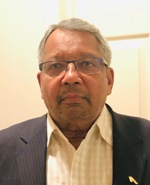
Kenneth Bainey
Edmonton, Alberta, Canada

Kenneth Bainey is a retired Chief Information Technology Officer and project management professional with more than four decades of experience across public, private and academic sectors- technology modernization, consulting, teaching, and executive delivery leadership. He has led and advised on complex projects involving governance, digital modernization, stakeholder alignment, risk, performance management, and organizational change. He is a part-time lecturer in project management and has taught PMP® preparation and applied project management in Canada, the United States, Europe, and the Caribbean.
He holds an MBA from Edinburgh Business School (UK) and a BSc from the University of Alberta, along with graduate Civil Engineering studies at the University of Calgary. He also holds multiple professional designations, including PMP, P.Mgr., BETI, CMgr., CIM, and CCP.
He is the author of two foundational textbooks:
Integrated IT Project Management (2003), Artech House Engineering publisher
Integrated IT Performance Management (2016), Taylor and Francis publisher
Both books focus on moving organizations from rigid processes and reporting to genuine performance, value, and accountability. He was also one of the reviewers of PMBOK® Guide v8 and v7, contributing practitioner insights into how principles, performance domains, and value concepts can better support real delivery. In 2020, he received the PMI Global Eric Jenett Project Management Excellence Award, recognizing his sustained contributions to the profession. Ken can be contacted at ken.bainey@shaw.ca
[1] PMI introduced M.O.R.E. in Step Up: Redefining the Path to Project Success with M.O.R.E. (2025). The four behaviours are Manage Perceptions, Own Success, Relentlessly Reassess, and Expand Perspective.