


and Building Energy Management Systems
for Sustainable Commercial Infrastructure
FEATURED PAPER
By Dr. Paulson Geo Philip
United Arab Emirates
Abstract
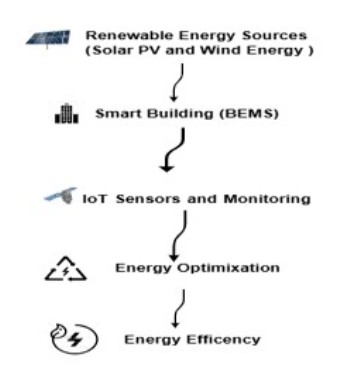
The rising energy requirement of commercial buildings and the need to have a sustainable energy solution has further generated the need to look at combining renewable energy technologies with the sophisticated energy management strategies. This paper explores how renewable energy systems can be integrated with Building Energy Management Systems (BEMS) in order to enhance energy efficiency and operational effectiveness in the commercial infrastructure. Through the proposed research, the authors provide an integrated framework through which renewable energy sources, such as solar PV and wind-based energy generation, are integrated with intelligent energy management system that is able to track, regulate, and optimize the energy use in the buildings. The model employs real time monitoring of data, forecasting of demand and automated control systems that balance the energy supply and demand in commercial buildings. The effectiveness of the proposed integrated system is analyzed using simulation-based analysis that is conducted under different conditions of energy demand. The findings show that the renewable energy coupled with BEMS greatly enhances energy efficiency, minimizes the use of conventional grid electricity, and lowers the operational costs. The system also helps to minimize the emissions of carbon and increase the sustainability of business infrastructure. Those findings indicate the significance of smart energy control and integration of renewable in contemporary building systems and offer useful guidelines to the creation of the energy-efficient commercial buildings. The paper provides a valuable strategic model in enhancing the energy performance of a building as well as contributing towards global sustainability and energy transition targets.
Keywords: BEMS; Commercial Infrastructure; Energy Efficiency; Energy Optimization; Renewable Energy; Smart Buildings
Graphical Abstract
- Introduction
The high rate of growth of the global energy requirement and the rising issues on sustainability of the environment have increased the necessity of effective energy management measures in the construction industry. The buildings contribute a considerable amount to the energy consumption and the release of greenhouse gases to the atmosphere, so they are one of the most important spheres where energy conservation and sustainable development efforts can be directed. Over the past few years, the shift to the low-carbon and net-zero energy systems promoted the use of renewable energy technologies and improved energy management systems in commercial and residential buildings. Research has pointed out that incorporation of renewable energy infrastructures in building systems can significantly lower the energy use and carbon emission in addition to enhancing the efficiency and sustainability of the entire system [3,4,10]. As digital technologies are being developed, intelligent BEMS have become the major solution to the energy performance optimization of modern buildings.
These systems combine sensors, automation solutions, and data analytics to equip control and monitoring of building operations in real-time mode. Data-driven strategies may help BEMS to become more energy-efficient, more flexible, and facilitated demand-response programs in smart grids. As highlighted by previous research, high-energy management schemes can help buildings to optimize the energy consumption trends without compromising the comfort of occupants and operational stability [5,6,12]. Moreover, the recent advancement in the data-driven technologies and performance indicators have made it possible to monitor and evaluate the building energy systems much more accurately, thus enhancing the efficiency of the energy optimization strategies [13].
More…
To read entire paper, click here
How to cite this paper: Philip, P. G. (2026). Integrated Renewable Energy and Building Energy Management Systems for Sustainable Commercial Infrastructure; PM World Journal, Vol. XV, Issue IX, September. Available online at https://pmworldjournal.com/wp-content/uploads/2026/09/pmwj168-Sep2026-Philip-Integrated-Renewable-Energy-management-system.pdf
About the Author

Dr. Paulson Geo Philip
Ajman, United Arab Emirates

Dr. Paulson Geo Philip is a Project Manager at UAE Television & Radio, Channel 4 Group, in Ajman, United Arab Emirates He is a project management and engineering professional, with over 14 years of experience across construction project management, MEP engineering, facility management, smart building systems, sustainable infrastructure, authority approvals, and mission-critical facility operations.
He currently serves as Project & Maintenance Manager with UAE Television & Radio – Channel 4 Group, Ajman, UAE. In this role, he is involved in project execution, MEP coordination, facility maintenance, contractor and vendor management, technical approvals, safety compliance, testing and commissioning coordination, and operational support for complex building and infrastructure environments.
Dr. Philip holds a Ph.D. in Project Management, an MBA in Project Management, and a B.Tech in Electrical and Electronics Engineering. His professional credentials include Project Management Professional (PMP), PMI Agile Certified Practitioner (PMI-ACP), PRINCE2 Practitioner, Lean Six Sigma Black Belt, LEED Green Associate, and LEED AP credentials. He is also associated with several professional and engineering bodies, including PMI, IET, APM, IEEE Senior Member, ASEE, AAAI, and SAE.
His professional and research interests focus on the practical integration of project management, engineering systems, sustainability, and emerging technologies in the built environment. His work particularly emphasizes construction project delivery, MEP coordination, energy management, smart and sustainable infrastructure, artificial intelligence in construction, renewable energy integration, HVAC optimization, and long-term operational reliability.
Dr. Philip has published scholarly papers related to project management, artificial intelligence in construction, intelligent building systems, renewable energy integration, and sustainable built environment practices. His published and scholarly works include topics such as Artificial Intelligence and Machine Learning Applications in Project Schedule Forecasting: A Predictive Framework for Time-Control in Complex Building Projects and Integrated Intelligent Building Energy Management: A Multi-Layer Framework for Renewable Energy, HVAC Optimization, and Smart Electrical Systems.
He is also the author of the published book Mastering MEP Approvals in UAE Construction Projects: A Practical Guide to Compliance, Coordination, and Authority Approvals, which reflects his practical experience in managing authority approvals, MEP coordination, compliance, and project delivery within the UAE construction sector.
Through his academic qualifications, professional certifications, published research, and industry leadership, Dr. Philip remains committed to advancing project management practices, engineering innovation, smart construction, and sustainable infrastructure development.
Email: paulsongeophilip@gmail.com
ORCID ID (0009-0008-1676-0190): https://orcid.org/0009-0008-1676-0190
Google Scholar Profile: – https://scholar.google.com/citations?user=_Mxye2wAAAAJ&hl=en