

How process maturity helps project teams
move faster, reduce rework, and build
value from one initiative to the next
ADVISORY ARTICLE
By Madison Lundquist
Principal Research Lead
Process and Performance Management
APQC
Texas, USA
Projects may be temporary, but the work patterns that shape their success rarely are.
Greater systematization of project architecture is becoming more urgent. Organizations are investing in automation and digital tools while asking teams to deliver projects faster, often with tighter budgets and leaner staffing. But modern platforms and AI tools do not automatically make projects more efficient. When project components are inconsistent or poorly defined, new tools can streamline project work on the surface while leaving the real sources of friction intact.
Research by the nonprofit American Productivity & Quality Center (APQC) on process maturity points to a practical insight for project leaders: The repeatable parts of project work need to be designed, managed, and improved with the same discipline as business processes.
From Templates to Project Components
The overlap between project management and process management points to the practices where process maturity can add the most value to project work (see Figure 1).
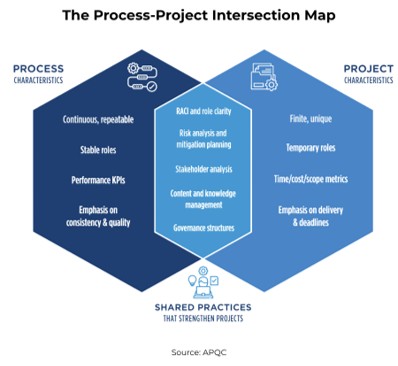
This image examines the characteristics that define projects and processes, along with their shared practices.
These areas – role clarity, risk and stakeholder analyses, knowledge and content management, and governance – are ripe for the kind of process development and discipline that saves time and energy in other parts of the business, generating value that compounds over time and across projects.
In organizations with process-mature project management, reuse extends beyond templates to include the context that makes those templates more useful. A stakeholder analysis, risk register, or governance model is easy to copy. But a copied artifact from a past project rarely gives the next team enough context to improve performance.
In process-mature organizations, project artifacts are paired with business rules, ownership, measures, and feedback loops. A risk register, for example, becomes part of a broader risk management component with common risk categories, escalation thresholds, decision rights, review cadence, and measures of risk response.
More…
To read entire article, click here
How to cite this article: Lundquist, M. (2026). Designing Project Architecture for Reuse: How process maturity helps project teams move faster, reduce rework, and build value from one initiative to the next, PM World Journal, Vol. XV, Issue VI, June, Available online at https://pmworldjournal.com/wp-content/uploads/2026/06/pmwj165-Jun2026-Lundquist-Designing-project-Architecture-for-Reuse.pdf
About the Author

Madison Lundquist
Texas, USA

Madison Lundquist leads APQC’s research on process and performance management. She uncovers best practices and performance metrics that help organizations improve efficiency and agility. Known for blending quantitative analysis with practical strategies, Madison’s work helps organizations develop data-driven process programs and adopt proven approaches to continuous improvement.
Email: mlundquist@apqc.org | Web: www.apqc.org
About APQC
APQC (American Productivity & Quality Center) is the world’s foremost authority in benchmarking, best practices, process and performance improvement, and knowledge management (KM). With more than 1,000 member organizations worldwide, APQC provides the information, data, and insights organizations need to support decision-making and develop internal skills. Learn more.