

Introduction to the Series
SERIES ARTICLE
By Dr. Prasad Kodukula and Guz Vinueza
USA and Ecuador
Artificial intelligence (AI) is rapidly reshaping how project professionals plan, make decisions, manage risk, communicate with stakeholders, and deliver value. Yet for many organizations, the main challenge is no longer gaining access to capable AI technologies. It is integrating those technologies into clearly defined, streamlined workflows, supporting adoption across the organization, establishing effective governance, and scaling successful applications beyond isolated experiments.
McKinsey’s 2026 survey1 of approximately 500 organizations on AI trust maturity found that only about 30 percent had reached higher maturity levels in AI strategy, governance, and agentic AI controls. Nearly two-thirds identified security and risk concerns as the leading obstacle to scaling agentic AI, while almost 60 percent cited knowledge and training gaps as a major barrier to responsible implementation.
The World Economic Forum2 similarly argues that realizing AI’s full potential requires organizations to rethink how work is performed, how decisions are made, and how operating models are designed—not merely to deploy new technology.
Together, these two studies suggest that the real challenge is not AI adoption itself but the organizational capacity to govern, integrate, and scale it effectively.
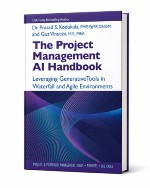 Drawing primarily on our best-selling book, The Project Management AI Handbook: Leveraging Generative Tools in Waterfall and Agile Environments3, this series will address these challenges through the practical application of AI in project and portfolio management.
The book goes beyond describing what AI can do. It explains the underlying project management processes and workflows and, through more than 50 use cases, demonstrates how Generative AI (Gen AI) can be applied in predictive, agile, hybrid, and portfolio environments.
More…
To read entire article, click here
Editor’s note: Dr. Prasad Kodukula and Guz Vinueza are the authors of the best-selling book titled The Project Management AI Handbook: Leveraging Generative Tools in Waterfall and Agile Environments, published in 2025 by J. Ross Publishing.
How to cite this work: Kodukula, P. S. and Vinueza, G. (2026). AI in Project Management, Introduction to the Series, PM World Journal, Vol. XV, Issue VIII, August. Available online at https://pmworldjournal.com/wp-content/uploads/2026/08/pmwj167-Aug2026-Kodukula-Vinueza-AI-in-PM-series-intro.pdf
About the Authors

Prasad S. Kodukula, USA
Illinois, USA

Dr. Prasad S. Kodukula, PMP, PgMP, PMI-ACP, DASM, DASSM, BCES, is a USA Today and Amazon #1 best-selling author, PMI Fellow, thought leader, and entrepreneur with over 35 years of professional experience. A global ambassador for project management, Dr. Kodukula has lectured in nearly 50 countries and worked with more than 40 Fortune 100 companies (e.g., Allstate, Abbott Labs, BP, Caterpillar, Dow, Chrysler, IBM, JP Morgan Chase, Motorola, Stryker, United Technologies, Whirlpool) across all 11 S&P industrial sectors. He serves as an Adjunct Industry Professor at Illinois Tech. He teaches how to recover troubled projects at NASA. He has delivered project management training in professional education programs at Stanford University, Duke University, and the University of Chicago. As co-founder and CEO of Kodukula & Associates, Inc. and NeoChloris, Inc., he leads the firms in project management and renewable energy, respectively.
His work with AI began in 1988, when he created award-winning expert systems in environmental engineering. In the late 1990s, he co-invented an AI-powered smart monitoring and control system for water and wastewater treatment plants, combining early neural network, sensor, and automation technologies. This invention received a U.S. patent in 2005 and was later licensed to prominent control and automation firms.
Recognized three times by the Project Management Institute as “Best of the Best in Project Management,” he has received multiple accolades, including the Illinois Tech Alumni Association Professional Achievement Award and honors from the U.S. Environmental Protection Agency and the states of Arizona, Kansas, and Illinois for his outstanding leadership in education and training, environmental improvement, and innovation. Most recently, he was recognized by Project Controls Academy with a Project Controls Excellence Award. An accomplished author, Dr. Kodukula has co-authored or contributed to 12 books and over 40 articles and holds four U.S. patents. He can be contacted at: https://www.linkedin.com/in/prasadkodukula/.

Guz Vinueza
Ecuador

Guz Vinueza, M.S., MBA, is a top expert in data analytics, machine learning, and quantitative risk management, with over 25 years of experience helping organizations utilize advanced technologies to create business value and manage uncertainty. He currently works as Consulting Director at The Ferryfield Group, a boutique consulting firm focused on quantitative risk software, where he manages global projects across various industries and regions. Previously, he was Data Director at Betterfly, Latin America’s first social-impact unicorn, overseeing enterprise data architecture, analytics, and machine learning initiatives to expand the company’s digital ecosystem. Earlier in his career, as Director of Consulting and Analytics Solutions at Palisade, he transformed the consulting division into an agile software and analytics team, tripling revenue and delivering solutions across Latin America, the U.S., and the Middle East.
An accomplished consultant, educator, and keynote speaker, Guz has trained thousands of professionals from leading organizations such as the U.S. Army Corps of Engineers, Ontario Power Generation, Amway, DEWA, Mitsubishi Pharmaceuticals, and Network Rail. He has also served as an Adjunct Professor in Analytics and Business Intelligence at institutions in Argentina, Ecuador, and Spain, teaching advanced analytics, agile methodologies, and project management. Guz holds an MBA from Universidad Torcuato Di Tella, an M.S. in Financial Direction from Universidad Adolfo Ibáñez, and a Postgraduate Certificate in AI and Machine Learning from the University of Texas at Austin. His work continues to shape the integration of AI, quantitative risk, and data-driven decision-making across global enterprises. He can be contacted at: https://www.linkedin.com/in/gustavovinueza/