

Project Management in the Age of AI:
Why Progress Is Impossible Without People
December 2025 PM Update from Germany
REPORT
By Sebastian Wieschowski
Nuremberg, Germany
Introduction
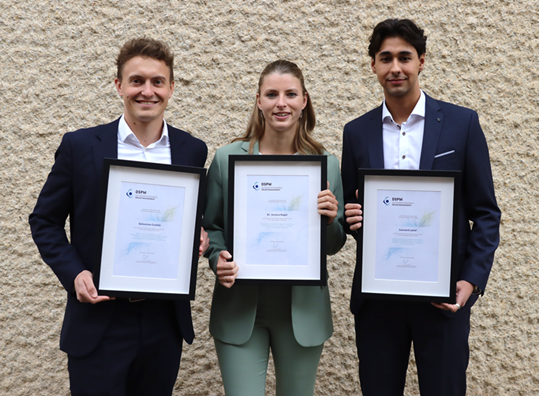
At a time when artificial intelligence analyzes projects, algorithms determine priorities, and digital tools shape daily work, three award-winning research papers from this year’s “German Student Award in Project Management” arrive at a strikingly clear and unanimous conclusion: none of it works without people. Whether it’s the maturity of project management structures, the quality of strategic decisions, or the competencies of digital teams, one pattern is unmistakable – technology only drives real progress when culture, trust, and sound judgment are part of the equation.
The three papers honored with the “German Student Award in Project Management,” (“Deutscher Studienpreis Projektmanagement”) presented by the GPM – German Association for Project Management, look beneath the surface of today’s project environments. They show how cultural factors determine success or failure, why AI in portfolio management only works in tandem with human expertise, and why digital transformation makes the social skills of project managers more important than ever. Together, they offer insight into the future of a profession that is becoming more technical – and simultaneously requires a stronger human focus.
- STRATEGIC SUCCESS THROUGH CULTURE: HOW AN AWARD-WINNING BACHELOR’S THESIS ANCHORS HUMAN AND ORGANIZATIONAL FACTORS IN PROJECT MANAGEMENT
Amid rising volatility, uncertainty, and complexity in modern business, project management has evolved from a simple toolset into a strategic core capability that drives transformation, innovation, and digitalization. Yet many projects continue to fall short of their goals. Often, the issue is not a lack of methodology but insufficient cultural grounding and inconsistent processes. Existing maturity models for assessing project management practices frequently operate on an overly abstract level and fail to capture organizational complexity. The need for a more practical instrument that realistically reflects cultural factors is more pressing than ever.
Award in the “Bachelor’s Thesis” Category
For his contribution to this critical topic, Leonard Latief – who completed his cooperative degree program at the Baden-Württemberg Cooperative State University in Heilbronn – was honored for his bachelor’s thesis titled “Project Management in Complex Organizations – Adapting a Maturity Model to Analyze Project Management Maturity Using the Example of the Markant Group.” In his work, Latief developed the Adapted Project Management Maturity Model (APM3), which renders an existing framework more applicable to real-world practice.
One of the thesis’s core findings is that project management involves far more than processes, methods, and techniques – a simple “toolbox” is not enough. Success is largely determined by the people who shape and drive projects…
More…
To read entire work, click here
How to cite this paper: Wieschowski, S. (2025). Young Researchers Explore Project Management in the Age of AI: Why Progress Is Impossible Without People, report; PM World Journal, Vol. XIV, Issue XII, December. Available online at: https://pmworldjournal.com/wp-content/uploads/2026/01/pmwj159-Dec2025-Wieschowski-german-student-awards-in-project-management-report.pdf
About the Author
Sebastian Wieschowski
Nuremberg, Germany

Sebastian Wieschowski is an editor at the German Project Management Association (GPM), the national member association of the International Project Management Association (IPMA) in Germany. He is responsible for developing GPM’s media relations and serves on the editorial board of PM Aktuell, a quarterly magazine distributed to more than 6,500 GPM members as well as external stakeholders.
Born in 1985 in northern Germany, Wieschowski developed an early fascination with journalism. His formal education began with active contributions to school and local newspapers. He later completed journalistic training at the Cologne Journalism School for Politics and Economics, earned a Master Level Diploma from the School of Journalism at Eichstaett University, and undertook professional training at a regional newspaper publisher. He also holds a postgraduate M.Sc. degree in Public Health from Hannover Medical School.
In addition to his freelance journalism for national and international outlets, including major German media such as DIE ZEIT, Wieschowski has held senior communications roles since 2012. He first worked as press officer for a private university specializing in social work, then for a psychiatric hospital, and later for an industrial company. In September 2024, he joined GPM’s Marketing and Public Relations department, where he focuses on strengthening the visibility and public relevance of project management through editorial formats such as storytelling.
Alongside his professional career, Sebastian Wieschowski is also active as a freelance author in his lifelong passion, numismatics. He writes for both German- and English-language specialist publications, and his work has been recognized three times by the Numismatic Literary Guild, a writers’ association based in the USA.
Sebastian is a reporter at heart and enjoys discovering inspiring stories and meet people from around the world, a goal that is particularly easy to pursue in the field of project management. He can be contacted at s.wieschowski@gpm-ipma.de.
To view other works by Sebastian, visit his author showcase in the PM World Library at https://pmworldlibrary.net/authors/sebastian-wieschowski/