

The structure behind the distribution
LETTER TO THE EDITOR
Ref: Lyaschenko, A. (2026). Probabilistic Activity Drag; PM World Journal, Vol. XV, Issue VII, July. Available online at https://pmworldjournal.com/wp-content/uploads/2026/07/pmwj166-Jul2026-Lyaschenko-Probabilistic-Activity-Drag.pdf
Dear Editor,
Alex Lyaschenko and I are connected on LinkedIn, and I have followed his writing on schedule optimisation for some time, so I read his featured paper on Probabilistic Activity Drag as soon as it appeared.
It is a careful and useful piece of work, and it closes a gap that has sat under the Drag family since Devaux introduced the metric in 1999. Drag has always been computed on a schedule whose durations are treated as known. Every planner knows they are not. By recomputing Drag inside each Monte Carlo iteration and aggregating the results, the paper replaces a single promised number with a range and a probability of achieving it. That is the right move, and it is made without losing the intuition that made Drag worth having.
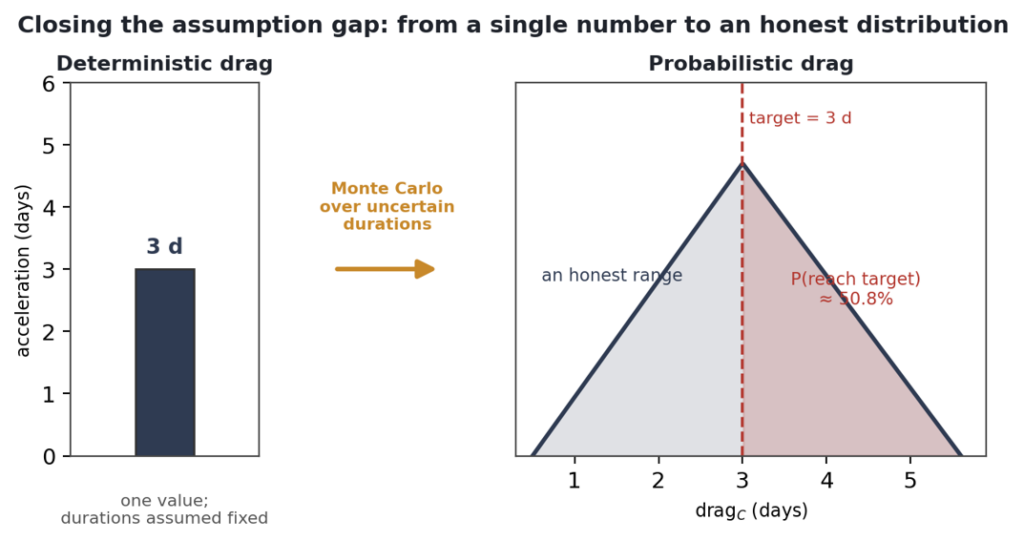
Figure 1. The gap the paper closes. Deterministic Drag reports one number and assumes the durations feeding it are known. Recomputing Drag inside each simulated iteration returns a range and the probability of reaching the target. On the paper’s own example the probability of achieving the three-day target on Activity C is 50.8%.
Several judgements in the paper deserve particular credit. Insisting that the schedule be calculated with real constraints in place, including resource availability, is not a small remark: it is the difference between a Drag figure a planner can act on and one that dissolves the moment the resource histogram is honoured. The paper is candid about what the metric does not do. It states plainly that Drag is not commutative, that reducing an activity to zero is usually not the right target and that crashed duration is the better one, and that acceleration cost sits outside the model although it often decides the answer. It also warns that a DCPM-based model can mislead precisely because it ignores resource limits.
Papers that advance a metric rarely list its boundaries this openly.
More…
To read entire Letter to the Editor, click here
How to cite this work: Dhand, Nikhil (2026). On Probabilistic Activity Drag: The structure behind the distribution, Letter to the Editor, PM World Journal, Vol. XV, Issue IX, September. Available online at https://pmworldjournal.com/wp-content/uploads/2026/09/pmwj168-Sep2026-Dhand-On-Probabilistic-Activity-Drag-Letter-to-Editor.pdf