

“Beyond resilience: towards antifragility”
PAPER REVIEW
By Thomas Walenta
Hackenheim, Germany
Abstract
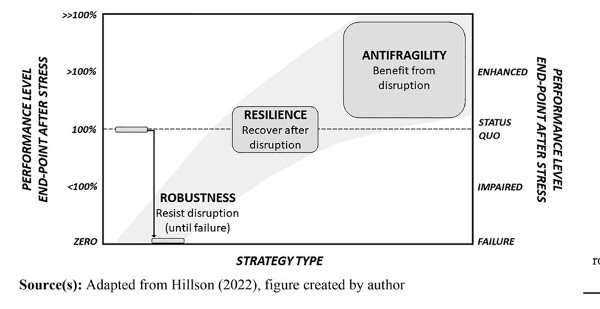
This review builds on Hillson’s discussion of antifragility by extending it with selected ideas from Taleb, including the Hydra metaphor, Seneca’s asymmetry, the barbell strategy, and via negativa. It examines how antifragility applies to project and program management, and suggests that programs may be particularly well suited to adaptive, benefit-driven outcomes. The paper also connects these ideas to Bendell’s feedback-loop perspective and Daoist philosophy, emphasizing contextual adaptation over rigid planning. It highlights areas for further research, including long-term strategies, centenarian organizations, and decision-making under uncertainty, and concludes that antifragility is not only about resilience but also a principle for learning, adaptation, and value creation. Overall, the paper argues that antifragility is not only about resilience, but also a principle for learning, adaptation, and value creation
Keywords: Antifragility, Robustness, Resilience, Sustainability, Program vs. Project Management, Chinese and Western culture
Introduction
This article builds on David Hillson’s 2023 opinion piece, “Beyond resilience: towards antifragility?” (Hillson, 2023) and broadens the discussion of antifragility for project and program management. Hillson’s paper and the accompanying webinar provide a practical entry point into a concept introduced by Nassim Nicholas Taleb in Antifragile: Things That Gain from Disorder (Taleb, 2012), which has since attracted growing interest across management and organizational studies.
The present review extends that discussion by drawing on several of Taleb’s core ideas, including the Hydra metaphor, Seneca’s asymmetry, the barbell strategy, optionality, and via negativa. It also considers Hillson’s notion of rheopecticity as a useful way to describe structural improvement under certain kinds of disturbance. On that basis, the paper examines how antifragility may be understood not only as a property of systems but also as a managerial principle for learning, adaptation, and value creation.
A further aim of the article is to explore whether antifragility is more naturally aligned with programs than with projects. While projects are typically defined by fixed scope, deadlines, and preplanned deliverables, programs are oriented toward benefits realization and longer-term value creation, which may make them more receptive to adaptation in the face of uncertainty. For that reason, the paper also connects antifragility to Bendell’s feedback-loop perspective, Daoist thought, and selected questions for future empirical research.
More…
To read entire article, click here
How to cite this work: Walenta, T. (2026). On David Hillson’s paper “Beyond resilience: towards antifragility”, paper review, PM World Journal, Vol. XV, Issue V, May. Available online at https://pmworldjournal.com/wp-content/uploads/2026/05/pmwj164-May2026-Walenta-on-David-Hillsons-paper-Antifragility.pdf
About the Author
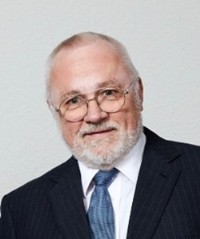
Thomas Walenta, PMP, PgMP
PMI Fellow
Hackenheim, Germany

Thomas Walenta brings more than 50 years of experience in projects, including over three decades in leadership and two decades in program management. He delivered his first project in 1974 and went on to spend much of his career at IBM, where from the mid-1990s he built PMOs, led complex programs, and successfully turned around troubled initiatives. His work included major SAP rollouts, outsourcing contracts, and portfolio integration across industries and regions. More recently, he supported a German manufacturer in introducing enterprise-wide portfolio management and a hybrid PMO. Over the years, his assignments have taken him through government, banking, insurance, electronics, and automotive sectors, and his professional journey has spanned Europe, Russia, the U.S., Japan, India, and nearly 100 countries worldwide.
Since 1998, Thomas has been an active volunteer with the Project Management Institute (PMI). He served as President of the PMI Frankfurt Chapter, completed two terms on PMI’s global Board of Directors, and spent five years on PMI’s Ethics Review Committee. In 2012, he received the PMI Fellow Award, awarded to fewer than 100 individuals worldwide. He has held the PMP since 1998 and the PgMP since 2014. He continues to volunteer for global PMI groups and works as an event manager for the local Chapter.
Thomas has led his own consulting business since 2001, taught project management at two universities for over 20 years and spoken at more than 100 international conferences. He has published extensively on project and program management, earned a diploma as a non-executive director from the UK’s Institute of Directors in 2017, and has been pursuing a DBA at SBS in Zurich since 2023. He also mentors around 15 professionals, apprentices, and refugees. Thomas lives in Hackenheim, near Frankfurt, Germany, and can be reached at thwalenta@online.de.