

Powering a Regenerative Future
Leading Sustainability and Regeneration in Projects
SERIES ARTICLE
By Dr. Hugo Minney
United Kingdom
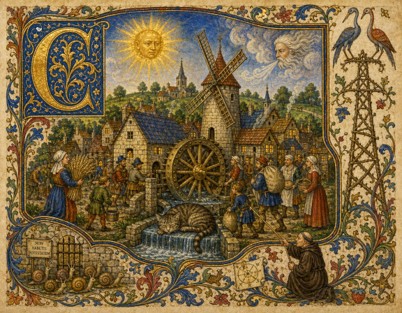
Figure 1 The commons at the mill: a village that owns what powers it, drawing on sun and wind alike — while the snails wait at the barred gate for a grid connection.
Abstract
Every credible pathway to net zero requires Great Britain’s electricity system to roughly triple in size by 2050, from around 290 TWh of annual demand today to between 705 and 797 TWh across the National Energy System Operator’s scenarios. The technical means to build that system are largely understood. What remains unresolved is the institutional question: who owns the generating assets, who carries which risks, who has visibility of what is happening on the network, and who pays when generation and network programmes fall out of step. This article, the eleventh in the series, examines energy generation and distribution as a portfolio of project decisions rather than a set of technologies. It traces the transition through Ørsted’s costly first-mover experience and the replication economics of Sizewell C; the grid connection queue that now binds delivery; the 2025 Iberian blackout as evidence that system stability has become a project deliverable rather than an operational afterthought; and the Great British Energy Local Power Plan’s wager that community and shared ownership convert public consent and local value into a durable asset. The Derril Water shutdown shows what happens when ownership outruns network readiness. A closure hierarchy — extend, repower, recycle, remove — tests whether “sustainable” was ever meant seriously, with the North Sea’s £44 billion decommissioning bill as the cost of closure unplanned. Throughout, the argument maps to the Five Ps, with Peace — energy security — carrying unusual weight.
Keywords: community energy; energy transition; grid connection; benefits realisation; decommissioning; Local Power Plan; shared ownership; system resilience; Five Ps; regeneration.
- Introduction: a collision between demand and supply
Every serious pathway to net zero in Great Britain requires the electricity system — the grid and the generators that feed it — to roughly triple in size within twenty-five years. This is the arithmetic of the system operator’s own published scenarios. The National Energy System Operator’s Future Energy Scenarios 2025 puts annual electricity demand at around 290 TWh today, rising to 705 TWh under its “Holistic Transition” pathway, 785 TWh under “Electric Engagement”, and 797 TWh under “Hydrogen Evolution” by 2050 (NESO 2025). Peak demand rises from present levels to somewhere between 120 GW and 151 GW. Total installed capacity reaches 439–450 GW. The fourth scenario, “Falling Behind”, is the one that misses net zero.
These numbers are also a statement about the portfolio. Tripling a national electricity system in twenty-five years represents a huge opportunity for project managers, and a challenge of a scale the United Kingdom has not attempted since the post-war build-out: commissioning generation, network, storage and flexibility assets at pace, while simultaneously decommissioning the fleet that is reaching the end of its life, and retaining support from the public so it doesn’t get undone partway through…
More…
To read entire report, click here
Editor’s note: The author Dr. Hugo Minney is a Fellow of APM (Association for Project Management), a Member of PMI and PMI UK, Chair of APM’s Benefits and Value IN and Sustainability IN, founder of APM Nuclear Industries IN and AI & Data Analytics IN, and chair of BSI’s Working Group on Benefits Management. Minney Org Ltd offers consultancy on ROI and SROI. For more, see his author profile at the end of this article
How to cite this work: Minney, H. (2026). Energy Generation and Distribution: Powering a Regenerative Future, Leading Sustainability and Regeneration in Projects, series article, PM World Journal, Volume XV, Issue IX, September. Available online at https://pmworldjournal.com/wp-content/uploads/2026/09/pmwj168-Sep2026-Minney-Powering-a-Regenerative-Future.pdf
About the Author

Dr Hugo Minney
London, UK

Dr. Hugo Minney is a Fellow of APM (Association for Project Management), a Member of PMI and PMI UK, Lead of APM’s Benefits and Value IN (Interest Network) and Sustainability IN, founder of APM’s Nuclear Industries IN and AI & Data Analytics IN, committee member of PMI UK’s Sustainability Community of Action and Board Member of the Non-Profit PM4theWorld (none of which are paid). Minney is also chair of the British Standards Institute’s working group on Benefits Management, which publishes and maintains BS 202002 (Applying benefits management on portfolios, programmes and projects) (also unpaid).
Minney is a business consultant. He analyses the benefits of change, and weighs them up against the need for effective operations to keep the lights on; he has built business cases of all types and is acutely aware of the pressures to make a single project a success at the expense of the organisation’s objectives and the need to resist this; as a former executive board director in National Health Service he can take a portfolio overview and prioritise the individual benefits of projects to ensure the success of the whole organisation. Minney is now a project management consultant with a sideline chairing a charity restoring the sense of community for young people.
Minney specialises in putting a number on difficult benefits (such as sustainability and regeneration), motivating team members by reporting what they are achieving together and motivating teams to build the communities and companies we want to be part of – together. He believes in standards and is accredited as a Social Value practitioner and Chartered Project Professional.
Dr. Minney can be contacted at hugo.minney@thesocialreturnco.org
To view previous works by Hugo Minney, visit his author showcase in the PM World Library at https://pmworldlibrary.net/authors/dr-hugo-minney/